The side project I ignored for years made my startup profitable overnight

The Context
My name is Sam, I have an actual AI background going back to 2008, with several research papers and a patent.
After graduation (2012) I wanted to go into software/tech - I applied for positions in the Bay Area, and while I knew “AI”, no one cared about that, I was rejected from every job I applied for because no one cared about AI and I didn’t know how to write apps.
I went to MIT for grad school (learned to code on the side) and after that I launched my first startup (an e-learning app in West Africa). That didn’t work out and we pivoted a few times before launching an SDK for AI features for WebRTC apps, we were then acquired by a customer during the pandemic.
I worked for the acquirer for a few years before they themselves were firesold to a PE firm in 2024. The whole experience gave me a bit of a distaste for VC, so I decided to start my 2nd startup to automate video editing, but reflecting on the mistakes from my first startup (built team +raised funds only to pivot 5 times), I figured I’d try and keep things lean, pivot quickly as needed, and figure out what was going to scale before trying to build a team and raise funds.
The “Real Project”
Why AI Video editing?
When my first startup (Vectorly) was acquired by Hopin in 2021, our team of 5 joined a 2000 person org overnight, but despite the number of talented engineers at Hopin, the 5 of us from Vectorly were the only ones who actually knew how to train and deploy custom AI models, so we became Hopin’s AI team and as the former CEO, I became the defacto “Head of AI” for the company.
They also acquired a product called Streamyard (browser-based livestreaming tool) which is where our AI filters SDK was deployed. As the pandemic crashed, Streamyard became Hopin’s most profitable product and so our team was shifted to managing AI features for Streamyard.
As the 2023 Gen AI boom kicked off, the Streamyard founders asked me to work on AI editing features for Streamyard so we did. As we looked at what other companies in our space were doing though, I saw that “AI Video Editing” was just transcribing video content, and sending prompts to ChatGPT (or some other LLM) - having spent years in lower-level ML and deep learning where actual R&D was the norm, this all felt incredibly stupid to me.
Why do a new startup?
At Streamyard I prototyped a way to train much smaller AI models to understand long-form video content and predict edits & cuts based on multi-modal information, and the AI models were able to edit long form content 100x faster, cheaper and with much better quality edits than any of the hundreds of ChatGPT wrappers.
It was just a prototype, but I figured, if it was that easy to do so much better of a job, why couldn’t you build a foundation model for video editing, that could eventually approach the quality of a professional human editor at editing arbitrary long-form video content like podcasts or wedding videos or highlight videos.
Hopin (along with it’s products like Streamyard) was firesold to a PE firm in April 2024. The Streamyard founders quit, and everyone from CEO to support staff was fired, and I decided to take this idea of building a foundation model for video editing and build my 2nd startup.
More pivots
The very first thing I did was recreate the same idea (but this time entirely from scratch, with my own code and my own data, I had to very carefully run everything by an IP lawyer), and I built the algorithm into a user-facing application to extract short-form interesting clips from podcast episodes, which I released in August 2024. While my algorithm was objectively better, faster and cheaper, this was a super crowded market and I’m also super bad at marketing, and the only people who used it were friends and family who tested it out.
From my conversations with amateur podcasters, a “clipping tool” didn’t obviate the need for either hiring an editor or learning editing software, so I shifted focus to a full editor, to edit full-length videos + clips, with a specific focus on Zoom videos to make a “complete product” in January 2025.
I actually had a number of users this time use the product, but it was still buggy, and users were spending 1-2 hours editing their content which went against the idea of “auto-editing” content.
From March to June 2025 I did a huge research + build sprint to build AI models to fully edit long-form podcast content, and built utility parts of the application to auto-generate intros, create thumbnails and otherwise produce an end-to-end solution that could take an amateur podcast editor from raw recording to finished everything in ~20 minutes.
First customers
I launched in July, and the only real content I did was this article which brought in ~100 people per month organically, and I ended up with 10 to 20 genuine active users per month.
From July to September 2025 I worked incessantly on fixing bugs, addressing usability and user feedback issues and finally adding in the paywall. It was messages like this that kept me motivated despite having spent 12+ months slaving away at this thing without revenue.
No worries at all, you’re providing what WILL be an amazing service for people like me…it will get there I am sure. Yes, that layout is correct altho I notice the chyrons are off-screen but i could live with that. My primary podcast release is audio-only but for episodes like this I love this solution you’re offering.
Within a month of launching the paywall, I’ve finally reached 10 customers (some beta users who converted, some new users who came after I put up the pay wall). Honestly, it’s more than I was expecting as I have yet to do any real marketing, but at $200/mo, I can only assume it’ll be a heroic amount of effort to grow it to non-trivial revenue.
My throwaway learning project
A lot of the reason my first startup was acquired was because we learned how to optimize and deploy neural networks directly in browsers via WebGL, which was much more efficient for browser-based AI video processing than using standard solutions like tensorflowjs or Google Mediapipe.
In 2023, while still working at Hopin, the successor to WebGL (called WebGPU) came out, and I wanted to practice writing Neural Networks in WebGPU. The pandemic was over, but deploying neural networks in the browser still seemed like a niche but super useful skillset and AI Upscaling just happened to be one of the simplest possible tasks to write Neural Networks from scratch for.
Free AI Video Upscaler started as a simple throwaway hobby project to practice writing neural networks in WebGPU, I built it over a few evenings (9pm to 2am) between Christmas and New Years 2023 while visiting my in-laws.
I didn’t really care if it didn’t work for the 50% of people coming to the website who didn’t have the latest version of Chrome/Edge with WebGPU, it was just a toy learning project that I shared in a reddit post.
I didn’t even bother coming up with a name for it, I literally just called it Free AI Video upscaler because that’s what it was. I didn’t care about the name, I didn’t care about SEO, the only thing I really cared about was not having a .ai domain.
When I got back from the holidays I just put the project on ice and ignored it for about 18 months.
Success despite my worst efforts
I had no intention of doing much with that tool. I had a job at a startup which had just gone through 4 rounds of layoffs, and I also had a family, so most of my efforts were spent on one major project (the auto-editing algorithm at Streamyard), as well as upskilling myself in all kinds of other Generative AI projects like:
- Building and training my own LLMs from scratch
- Trying to reverse engineer Adobe Podcast
- Building long-form content understanding/embedding models
This burst of effort and side projects was motivated by a deep-seated fear of job security, and I wanted to make sure I was one of the last people to be considered for firing, and make sure I had options if I ever was fired.
I did get fired (to be fair, so did the CEO and everyone else because Private Equity). I decided to do my 2nd startup (for a variety of reasons) and I would go all-in, and I’ve been going all in it for the past 18 months.
I did not have time to respond to reddit messages and bug reports for some random side tool I launched as a learning project.
The organic growth (That I willfully ignored)
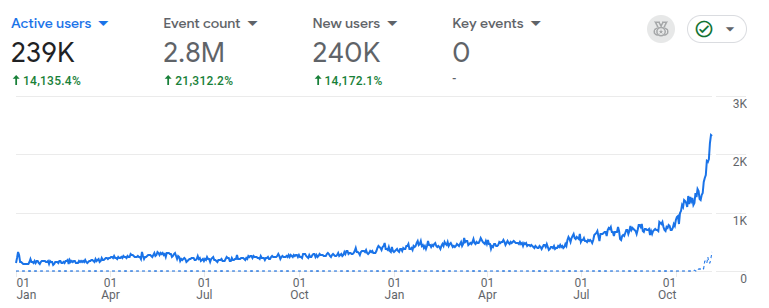
While I was slaving away at my AI Editing tool, I didn’t notice that my app (which averaged ~3K Monthly Active Users at launch) had been slowly growing at ~15% Month over Month without any effort on my part.
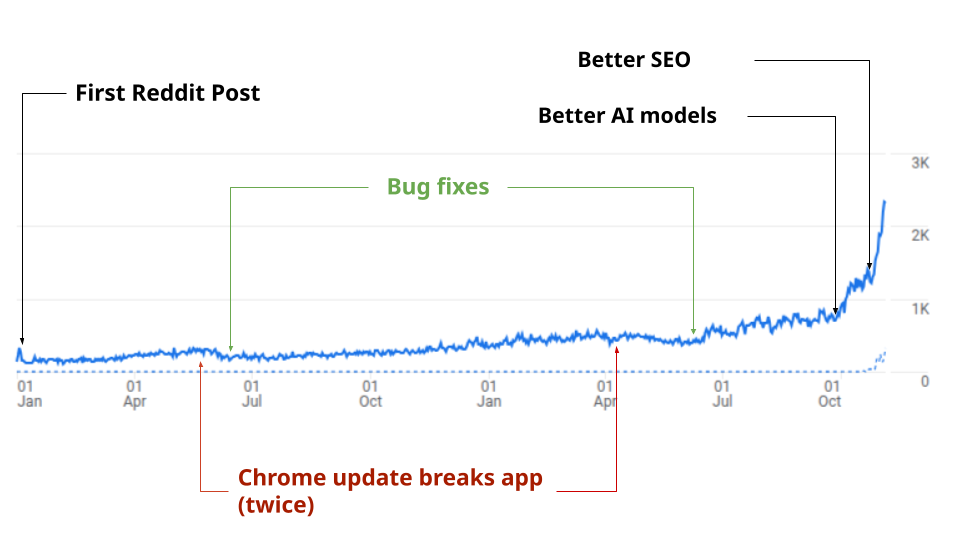
The only thing I really did was step in twice, once in June 2024, and again in June 2025, in response to Google Chrome (technically Chromium) updates that broke the encoding loop.
I would get messages on Reddit and bug reports on github, and I’d just ignore them, like “I don’t have time for this stuff”.
From April 2025 to June 2025, I got so many messages and I just kept ignoring them because I already had my hands full fixing bugs for people who were using Katana.
After I think 15+ different independent messages over the course of 5 weeks from April to June 2025 though, I finally got around to debugging and fixing the 2nd Chrome bug, and I despised doing it because I spent two valuable days that I didn’t have, to fix some random side project that no one was paying me to fix or maintain, while my actual main project was in crisis/pivot mode.
“No one would pay for this”
It was then that I noticed that the app had grown to 30K Monthly Active Users by itself, despite me ignoring bugs and other issues.
I had a call with an old friend/colleague from Vectorly, and we talked about this upscaling tool. I was pretty adamant that no one would ever pay for an upscaling tool, the reason people came to https://free.upscaler.video was precisely because it was free, I joked that no one would go to “https://paid.upscaler.video”
I was already considering pivots with Katana, and Saurabh and I discussed a landing page approach for various other ideas, so then I was like “Okay, it would only take a few hours to put up a landing page for a paid version of this upscaling tool, sure why not?”
So I vibe coded a landing page in 2 hours, and I literally just came up with some random pricing ($5 per hour of video upscaled) based on gut feeling, and put an offer saying “$1 deposit for $20 USD (4 hours) of upscaling credits” and put a link to it in the free upscaler tool.
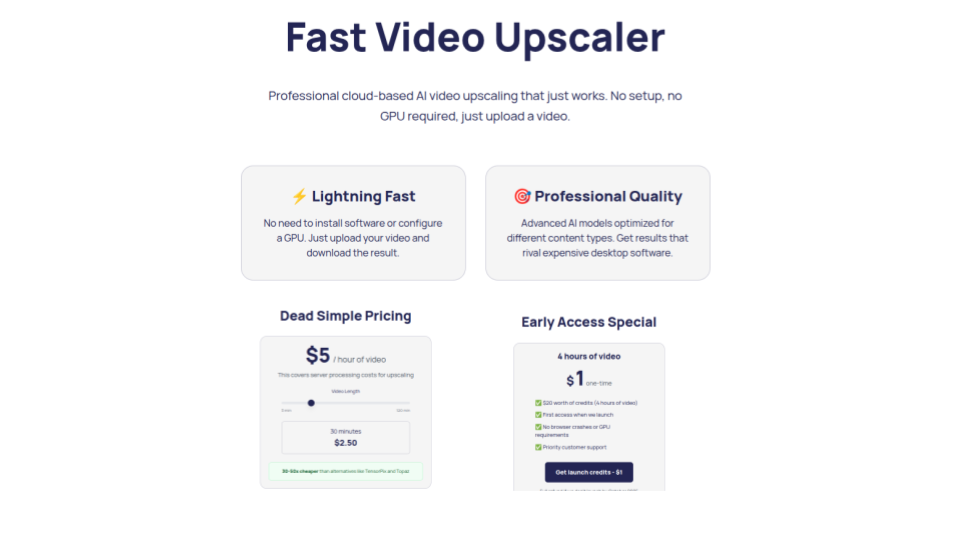
I decided ahead of time that if, in one month, 30 people paid a deposit, I’d consider it. If 60 people paid a deposit, I’d definitely do it. In one month (July 15th to August 15th) I actually had 103 people pay a deposit.
I begrudgingly decided, okay, let’s go take this thing seriously.
I built the paid version out of obligation
I had actual users for Katana using the app and facing bugs, and I had 2 podcaster conferences, and I moved in August, so things were pretty busy to have dropped everything and actually go build the paid version.
It was only because I put on the page “This service will launch before October 1st or you get your deposit back” that I had any pressure to actually go build it.
You have to understand that with AI Upscaling, most tools would just use existing AI models and if you were to approach this from a “normal developer” perspective you’d work out the cost of running those AI models on GPU hardware and derive your internal costs, and then set pricing to cover your internal costs.
I chose $5 / hour entirely arbitrarily (it felt right), but it was also ~50x cheaper than every other upscaling tool precisely because that’s the pricing you’d need to charge if you did things the way a “normal developer” would.
I have enough domain expertise to do my own R&D though, so while others would choose a pricing model to fit existing AI models, I did custom R&D to come up with AI models that fit the pricing model that I had arbitrarily chosen.
That was probably the only part that definitely couldn’t be vibe coded, and it did require about 6 weeks of R&D, with ~100 training runs and $5000 of GPU training costs, but when the models “felt good enough” to me (end of September), I vibe coded the “app” part (the frontend and backend) over a weekend, and launched it literally on September 30th, and sent emails with $20 in credits to all the early access subscribers on October 1st, the last possible day before I was supposed to give them a refund.
Rewarded for doing the bare minimum
I then shifted to making some changes in the free version. Learning from the R&D in the paid version, I threw Anime4K (popular Open source model used for the free version) out the window, and built my own custom AI models. Given the R&D and my expertise, this was pretty easy, I got this part done in 2 days.
I then asked Claude for help on sprucing up the website, and Claude helped me add in a better title, description and other SEO fields / schemas to the website, as well as some translations and a sitemap.
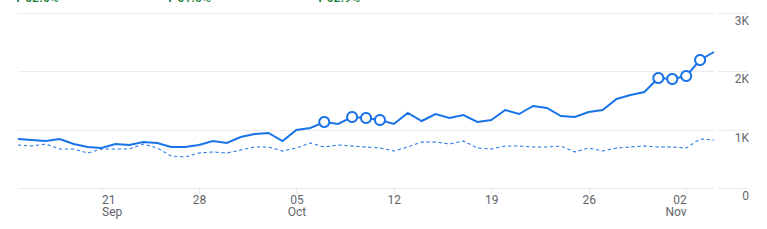
I think a week after launching these, my traffic from Google immediately jumped from 1k visitors per day to 2k visitors per day (and growing), reaching 2.5K users per day by the end of October.
Profitable Overnight with Zero Marketing
While building the paid version, I removed the landing page link from free.upscaler.video. When I added the link back in October, I suddenly had hundreds of people coming to the paid version every day, with about 50% signing up and ~8% converting.
Here’s the actual revenue so far:
| Month | Revenue |
|---|---|
| September | $0 |
| October | $1400 |
| November | $2800 |
I have such trivially low costs that even at ~$3k I’m just about profitable (it helps that I live in Mexico, my wife works), and sure, this is trivially low revenue in the grand scheme of things, but
(1) After years of worrying about runway, it’s nice to see the bank account go up
(2) I also haven’t done any marketing (yet)
I haven’t done anything to try to convince anyone to use my software, people just show up and pay me.
I fully came into the startup game assuming and expecting that it would take a heroic amount of effort to even reach profitability, and that “build it and they will come” is a false narrative that naïve developers fool themselves with when just getting into startup land. I was certainly there when I started making apps in 2015.
But I built it, and they came, and I became profitable with zero marketing. While it’s trivially low revenue (and about $200/mo is from my other project Katana), the fact that I’m profitable with zero marketing breaks my brain, and goes against core assumptions and common wisdom about entrepreneurship.
I don’t think it’ll grow any further without actual marketing (and so consider this post itself one of my first forays into content marketing), and I am worried that some of the SEO might be from Google’s honeymoon rankings, and so I’ll need to actually do marketing going forward regardless.
But if the goal were to try and get a product to $10k MRR, then it seems much more straightforward to get this upscaling tool to $10K MRR than my “main project”.
What I Learned
Some of this is just real time train of thought. I’ve been coding and talking to users non-stop for 18 months, and I’m still trying to make sense of it all. That said, here are some takeaways I’ve concluded (at least for myself, based on my experiences).
Lesson 1: Inputs ≠ Outputs
I spent 18 months building an AI Video Editing application with 10 customers and ~$200/mo in MRR. I spent ~1 month of effort on this upscaling tool with hundreds of customers and ~$3k MRR.
This is just a much tinier microcosm of a much broader pattern which I’ve seen to hold true in startup land, that Inputs ≠ Outputs, and I’ve seen it with my own eyes.
Hopin raised a billion dollars during the pandemic. By 2023, it was clear that Hopin as a product could be run by fewer than 50 people, and Streamyard, bootstrapped to profitability by the founders, ran a much more successful product with a much smaller team.
Having worked with both teams between 2022 to 2024, I had a somewhat external, yet still first-hand view to both products and teams, and corroborating with my own experiences with my first startup, I internalized that how much time/money/effort that goes into a project doesn’t correlate strongly with how successful it is.
Lesson 2: Roll the ball downhill
I have probably pivoted a company more times than most entrepreneurs, but not without reason. In my first startup, we sank years into
- An e-learning app
- Vimeo for emerging markets
- Video Compression algorithm
I’d like to think we weren’t entirely stupid - we had former very successful industry folks as sponsors, investors and advisors (MIT, former Founder / CTO of Hulu, former founder of Elemental / sold to AWS), and yet the ideas we tried clearly never worked.
It was only the last idea, the AI filters SDK, that actually worked. From the blog post:
Literally 2 days after we updated our website, but before we told anyone about it (we were preparing our e-mail campaign), a company randomly signed up and sent us an email asking us how to pay (we hadn’t even set up billing at this point). On July 1st, within 24 hours of that email, we had gotten on a call with the company, helped them integrate our SDK into production, set up Stripe, sent them a payment link, and booked our first real customer payment ever.
We had spent years trying to get someone, anyone, to use our other products, but within a month of launching the AI Filters SDK, we had multiple $10k checks from enterprises, almost all from inbound requests and referrals.
This upscaling tool is the 2nd time in my life where I’ve launched a product and just became profitable overnight.
Like, I understand the concept of hard work, and I am motivated enough to eat tons of glass and bust my *** off to make something work, but I’ve seen now multiple times that some projects feel like it’s rolling a boulder uphill for years, and some projects just roll down hill.
Rather than trying to raise money and hire people to try and brute force an idea/project where the reaction from users and customers is “meh”, everyone in the world might be better off, and you’d waste less time effort stress and money, by finding a project where there’s much more obviously product market fit.
Lesson 3: Free + Open Source can totally work
This is not one I expected, but using free.upscaler.video as a free/open source tool has meant it has helped me grow this very easily and organically to a much larger audience than I possibly could have reached via sales.
It’s a lot easier to share software solutions on places like Reddit when it’s actually free and open source, and the fact that this can also work as a lead mechanism for a paid solution is something I was aware of as a business model (though more for dev tools), but never something I have actually tried in the past.
While I’ve been in the startup game for years, there’s so many things I still don’t know how to do (like SEO marketing), and I’m totally down to learn - now that I’ve seen this free+open source tool work (and having had success with Dev tools in the past), I might try my hand at something along these lines in the future, for an actual dev tool.
Lesson 4: Listen to the spidey sense
I forgot to mention this earlier, but the reason I even decided to launch a user-facing app in the first place was because in Vectorly, in one of our pivots we had an SDK to implement AI Upscaling in the browser, and when we shared some posts on Reddit and Hacker News, we had a ton of people sign up

After talking with some of them though, we realized most of these users weren’t developers looking to integrate AI Upscaling into an app, rather they were regular users who just wanted to upscale a video. They signed up, thinking we had an upscaling tool.
We eventually pivoted to our AI Filters SDK, but it hadn’t escaped me that we had hundreds of people signing up for our Upscaler SDK looking for an upscaling solution. In the end, as a startup, we decided not to do anything with that information despite it being an early intriguing signal of some kind of latent demand.
That early signal was the reason I decided to not just release an Upscaling SDK but also an end-user facing tool and share it on reddit
What do I do now?
I don’t think the upscaling tool will ever be the basis for a big company. That said, the organic demand seems too interesting to not follow up on.
I’m not sure what I want to work on, but I have ideas
I am also exceedingly technical, and for me the idea of building 10x better technology than the state of the art is something that is both easier and something I’m more comfortable doing than even basic sales or marketing.
You could argue that I’m just very technical and I’d be better off as a CTO and find someone better at sales/marketing as a co-founder. That’s fair, but I’d counter that
(1) I struggle a lot with bugs, so if you were a non-technical founder looking for a technical co-founder like me to build a stable functional consumer or SaaS product, I could do it quickly, but it’d likely be full of bugs, which is what I’ve spent most of the last 18 months fixing with Katana.
(2) To be blunt, non-technical people tend to have technically uninspiring ideas. At Katana, I’ve built tons of user-facing usability + quality of life features, and I discovered even when those are my ideas, I don’t really like working on them, I do them because I want the product to succeed, not because I actually enjoy building those kinds of features. The only part of Katana I genuinely enjoyed building were the AI custom models that made it 100x better/faster/cheaper.
(3) I’ve been working on the side on an algorithm that could improve the speed & accuracy of transcription models by 10x - it’s based on solid and elegant math, but it’d probably takes weeks or months of R&D.
If I’m more of an inventor and prototyper (and someone who could actually build 10x better tech solutions), then maybe I should go work on inventing and prototyping highly technical ideas, and get help when one of them actually works as a scalable business.
One thing that really helped in my previous startup was that our co-founder / CTO was almost my exact opposite, he wasn’t great at ideating/prototyping, but he was fantastic at building stable production services and managing a team.
In either case, I’d still need to learn sales and marketing regardless.
Work on the free upscaler tool
It seems eminently straightforward then to just keep working on this free upscaling tool.
I’m genuinely convinced it’s the best free upscaling tool in the world, not because it’s my product, but because the data, both qualitative and quantitative, tell me that for what most people are looking for (simple, quick free no-nonsense upscaling), my technical approach (efficient client-side AI models in the browser) is better than every other solution for very specific structural reasons (it works, no config, nothing to install, results are reasonably good compared to AI models 1000x the size).
I don’t see why it couldn’t be the #1 free upscaling tool. If there are 1 million monthly searches on Google for AI upscaling, then I should be able to 10x my traffic with marketing.
The revenue would certainly help with trying out experimental ideas and/or further pivots for Katana without (1) needing to raise a round, (2) the risk of failure.
It would also help practice my biggest weakness as an entrepreneur, which is marketing & sales, which would probably help for any future project I’d like to work on.
Evaluate what to do next
Like I mentioned, I still have Katana, my auto-editing app with 10 customers. I have some other ideas (like the transcription thing I mentioned) which, if they worked, would also be obvious no brainers.
If you accept my takeaways thus far, the most logical thing in the world to do would be to do marketing for this upscaling tool, and then start exploring potential pivots for Katana (perhaps in a more B2B direction, where 100x better/faster/cheaper AI auto-editing is more quantifiable than when used in a B2C app) or completely tangential ideas like the transcription thing.
I don’t know ahead of time what’s going to work, but I’d like to eventually find a project where
- The ball rolls downhill
- It has the potential to grow substantially
If one of those projects does succeed, I’d be able to then grow a team (and raise money if necessary) for something that’s obviously working, rather than asking everyone involved to make a leap of faith.
Thanks for reading!
This is a train of thought blog written in the middle of my entrepreneurial journey. You can find me at (@sam_bha) on twitter, @sb2702 on Github, sam_bha on Reddit or on LinkedIn.
And of course, if you need a video upscaled in the future, you know where to go.